Willis D. Dudley
WILLIS D. DUDLEY WAS BORN IN TENNESSEE about 1860, in a state where slavery was still an accepted fact of daily life. Though no document survives to tell us whether he was born free or enslaved, history offers its own answer: the chances overwhelmingly favor the latter. Like many of his generation, Dudley likely took his first steps toward manhood during Reconstruction, carrying little from childhood except resilience and the determination to shape a life of his own.
Dudley married Mary Etta Ezel in Tennessee in 1882, and their daughter, Elnora, was born on March 21, 1883. No record of their marriage has been located, but the union is attested to repeatedly in later sources. After Elnora’s birth, the family fades from view for nearly a decade.
They reappear in 1892, when Dudley is found in Salt Lake City, Utah, working as a porter. City directories trace him in that occupation through 1896, when he is briefly listed as tending bar at the Oxford Saloon. He returned to porter work from 1897 through 1899, a pattern common among working men who moved between service and hospitality positions as opportunities arose.
That same year, Wilson Lodge No. 1 of the African Free and Accepted Masons was organized in Salt Lake City, and an article in the Salt Lake Herald reported that Dudley was installed in the office of Tiler. He and his family remained active in the organization for several years. Both Willis and Mary were later inducted into the Queen of Sheba Chapter, Utah Division, of the Daughters of the Sphinx of North and South America. Dudley rose within the order, becoming a thirty-second-degree Mason and, on August 22, being named Grand Chancellor.
On January 24, 1896, the Salt Lake Tribune published a lengthy article announcing the closure of Bacon’s Bank and listing its depositors. Among them was Willis D. Dudley, who held a savings balance of $110.70—approximately $3,300 in today’s dollars—suggesting a measure of financial stability uncommon for many African American working men of the period. That same year, he was employed as a bartender at the Oxford Saloon.
In August 1898, Salt Lake’s African American newspaper, The Broad Ax, reported that Will Dudley, “who is a member of our race,” had opened a cigar store. The paper described him as “well and favorably known” and deserving of generous patronage from the community. An advertisement printed the following week promoted cigars, tobacco, root beer, soda water, and fruit.
During this period, Dudley’s brother, Varnell, was also living in Salt Lake City, further confirming the family’s presence there in the late 1890s.
City directories from 1898 through 1901 again list Dudley as a porter, though the place of employment is not identified.
The 1900 U.S. Census offers a revealing glimpse into the family’s circumstances. Mary Dudley was listed as the head of household and the proprietor of a rented boarding house occupied by twenty-two tenants, including men, women, and children. She reported her marital status as “married,” though Willis was not residing in the household at the time. The family had expanded to include Charlotte, age one, whom Mary identified as her adopted daughter; the child’s parentage is unknown. Mary also reported having given birth to another child who had since died. Willis Dudley does not appear elsewhere in the census, but his absence is consistent with his elusiveness in earlier enumerations.
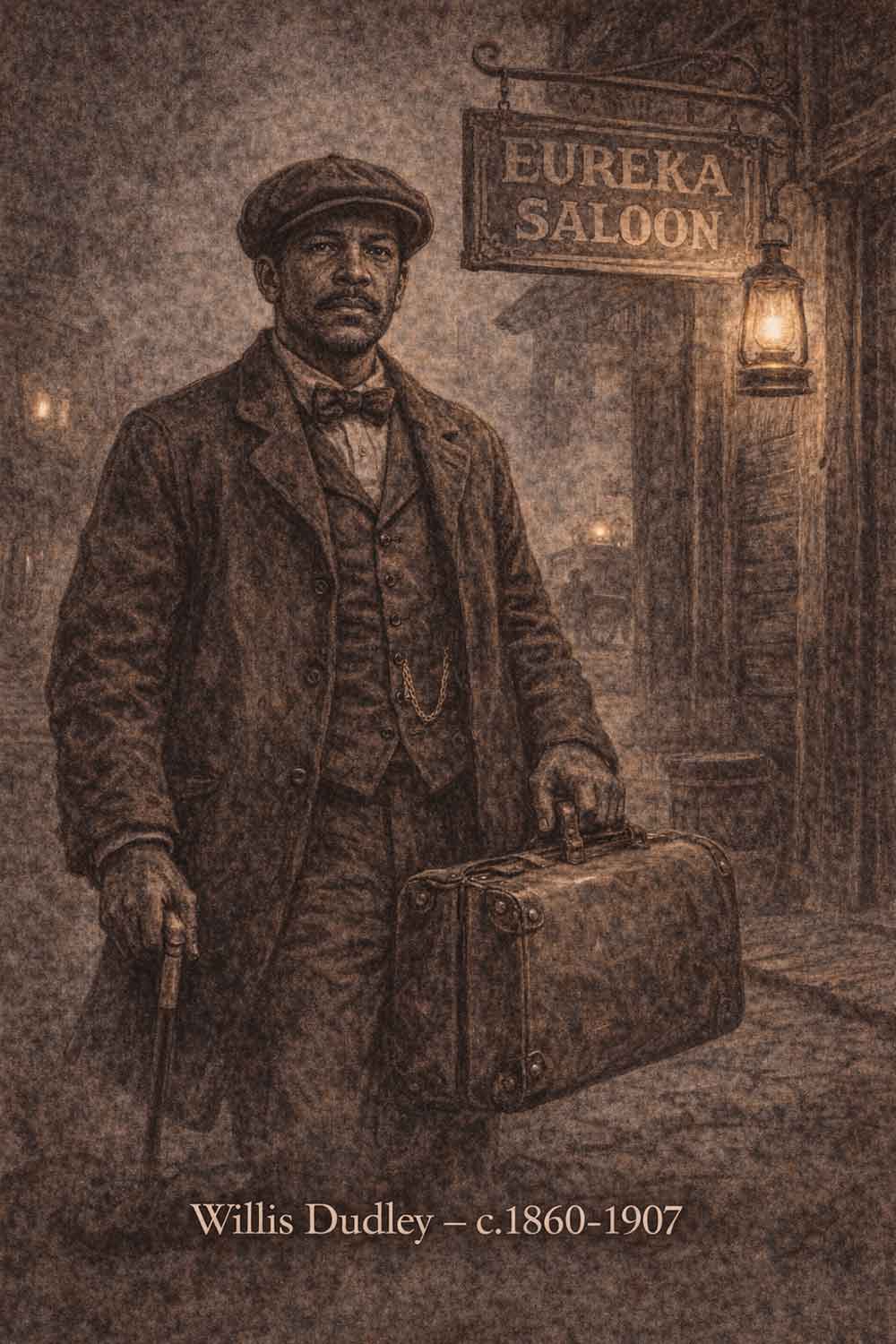
After 1901, Dudley disappears from the historical record until late 1907. On December 27 of that year, the Tonopah Daily Bonanza reported his death in a cabin behind the Eureka Saloon. He was placed in a hack for transport to the county hospital but died before it arrived, having been ill only since the night before. The paper observed that “death had too firm a grip on him to be counteracted by attendance.” At the time of his death, Dudley was employed by Renfro’s auto stage, likely once again as a porter. His obituary stated that he had come to Tonopah from Salt Lake City, was divorced, and was survived by one daughter.
Dudley’s residence behind the Eureka Saloon places him in close proximity to one of Tonopah’s most prominent establishments, owned by George “Devil” Davis. Given Dudley’s long work history in saloons and porter service, and the common practice of housing workers on site, it is reasonable to suppose that he may have been employed at the Eureka or otherwise connected with its operations, though no record has been found to state this directly.
Later records complicate the account of his personal life. Mary Etta Dudley died in Salt Lake City in 1931, and her death certificate identified her as widowed, in contrast to Willis’s obituary, which described him as divorced. No documentation of either the Dudleys’ marriage or a subsequent divorce has been located. Whether the couple formally dissolved their union or simply lived apart remains unknown. The contradiction stands unresolved, a reminder that official records often reflect circumstance, perspective, or convenience rather than certainty.
What can be said with confidence is that Willis D. Dudley lived a life of movement and effort—working, saving, organizing, and participating fully in the institutions of his community. That his presence survives only in fragments is not evidence of insignificance, but of how easily the lives of ordinary people, particularly African Americans of his generation, slipped beyond the margins of the written record.
CLICK ON THE IMAGE TO ENLARGE