
Frederick B. Parker
FREDERICK B. PARKER WSA BORN in Corpus Christi, Texas, in June 1853, the son of Thomas Smith Parker, Sr., and Rachel Thornton, and a grandson of Dr. Wm. H. Parker, one of the early white settlers of Texas. He was well educated and, by all accounts, became a typical Texan. In 1870 he was still living at home and working as a carpenter. During the Apache Wars he served as an official Spanish interpreter for U.S. Army generals.
When construction began on the Mexican Central Railroad, Parker drifted among the mining camps of Mexico, beginning the restless, roving life of a prospector. From there he ranged through New Mexico, Arizona, Colorado, Southern California, and finally Nevada—always in the vanguard of the next excitement.
The March 12, 1893 edition of the Arizona Republic reported that Parker embarked on a prospecting trip from Phoenix to Harquahala and the Grand Canyon with Black Jack Harvey. They prepared for a long and arduous journey, taking five burros “loaded to the bows” with provisions, blankets, clothing, and camping and prospecting equipment, along with the means to survive once their supplies were exhausted. Two years earlier they had attempted the same route but were driven back by extreme conditions and lack of water.
The December 2, 1893, edition reported that Parker returned alone from an extended prospecting trip to the Colorado River range. He observed that American miners were rapidly being replaced by “Cousin Jacks,” the highly skilled miners from Cornwall, England. From there Parker could be found at the Ubehebe copper mines in Death Valley, California, and later in Hawthorne, Nevada. It is assumed he was prospecting in the surrounding country, and the May 9, 1900, edition of the Walker Lake Bulletin noted that Parker and E. J. Purdy were granted a permit to kill wild horses on the Nye Canyon range.
From Hawthorne it was a short jump to the new boom camp of Tonopah. Parker was among the early arrivals, but by January 1902 he was one of the first to die during what became known as the “Tonopah Plague.” George Cole, writing for the Carson City Appeal, recalled:
“First of all, went Parker, my old partner, a gray sun-dried soldier of the desert. We had walked together behind a burro for days and slept together under the stars at night, but as men crawl like insects over the sands of the desert, they don’t waste time in talking of personal history. So, while I knew much of what he was, I knew little of what he had been.
“It seemed the proper thing that this old pioneer of many camps should lead the way to the new diggings of God’s Half Acre, where we all, eventually, make our pile and go home to rest. Parker must have been a soldier somewhere, for he didn’t linger long in his blankets before starting on that last long prospecting trip.
“‘B-Bill,’ he said, ‘m-my heart’s s-smothering.’
“Then he collapsed, didn’t speak again, and died a few hours later.”
In his many journeys Parker located and sold numerous properties, though in later years the proceeds were said to have been “wafted away like feathers in the zephyrs.” Among mining men his judgment of the character, extent, and value of mineral properties was widely respected, and it was well known that no amount of money could sway the expression of his honest opinion.
He was laid away by the kind hands of Tonopah friends, in whose eyes his faults were outweighed by his peaceful disposition, educational attainments, and sterling honesty. Parker was 48 years old, and “heart failure” was listed as the cause of death on his handwritten death certificate.
CLICK ON THE IMAGE TO ENLARGE

Click on an image to enlarge
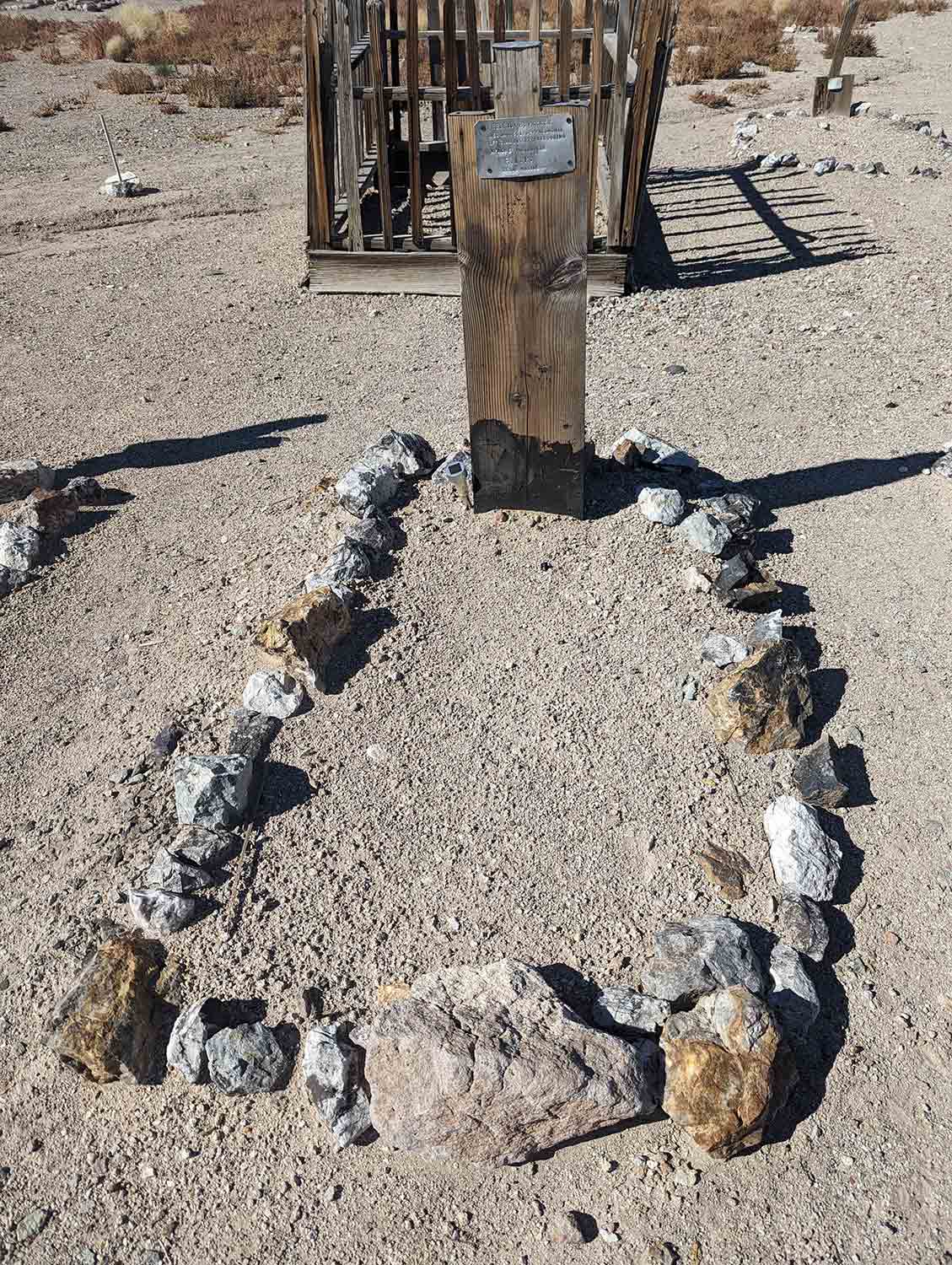
Frederick B. Parker gravesite
