Merrick Price Booth
MERRICK PRICE BOOTH WAS BORN in September 1847 in Alton, Illinois. His father, John Price Booth, a printer by trade, moved from Gold Hill, Nevada, to Austin, Nevada, in 1878 with his wife, Catherine Jane Price Booth, and their five children. There he purchased an interest in the Reese River Reveille and remained its publisher and proprietor, as well as that of the Belmont Courier, until his death in Austin in 1884. Another son, William W. Booth, later founded Tonopah’s first newspaper in 1901.
Merrick Booth listed his occupation as “farmer” when, at the age of twenty-three, he registered to vote in Stanislaus County, California, on June 10, 1871. By 1880, he was living in Grantsville, Nye County, Nevada, where he continued his interest in mining that started on the Comstock. He continued in that occupation for many years, his work carrying him to Paradise Valley, Winnemucca, Tuscarora, and Battle Mountain, Nevada, as well as to Idaho, Arizona, and Montana.
On May 6, 1898, Booth enlisted at Elko, Nevada, in the Second United States Volunteer Cavalry. Troop M, of which he was a member, was mustered at Carson City on May 14, 1898, and ordered by the War Department to report to Fort D. A. Russell, Wyoming. Booth was among the first volunteers from Tuscarora to answer the call for the Spanish–American War. His service was brief, however, and in August 1898 he was honorably discharged from Torrey’s Rough Riders after a medical examination showed him to be over age and physically incapacitated. A notice in the August 3, 1898, edition of the Salt Lake Tribune reported that Booth was in Ogden that week on his way home to Nevada, having been placed on sick leave. Shortly after returning to Elko, he announced his candidacy for the Nevada State Assembly, but did not win. In 1900, according to the 1900 U.S. Census, he had moved on to Owyhee, Idaho where he was working as a car man in the mining industry.
Following the discovery of Tonopah, Booth was among the earliest arrivals in the new camp, having followed his brother there. He secured employment at the Belmont–Tonopah Mine. In 1902, he announced himself as an independent candidate for the office of constable of the Tonopah district, though he was unsuccessful. He had earlier run, also unsuccessfully, for the same office in Tuscarora in 1892.
In December 1902, Booth was hired by downtown Tonopah business owners as a night watchman. It was while serving in that capacity that he was arrested in 1903 on what was widely regarded as a flimsy charge of carrying a concealed weapon. The Tonopah Bonanza editorialized:
“Booth has been night watchman in Tonopah for about ten months, and his zeal and watchfulness have attracted the attention of a big majority of property owners on Main Street and caused them to stop the pay of the constables, which the latter have been drawing, but not earning, and transfer the same to Booth. This aroused the anger of the officer and is the animus of the charge against him.”
The following week, a jury returned a verdict of not guilty after deliberating for only five minutes.
Merrick again found himself in legal difficulty in early April 1904, when he was arrested for firing nine shots at Fred Sweeney. The Tonopah Miner reported on May 7 that “it is rumored that the trouble was caused by a woman.” After the state presented its evidence at the preliminary hearing, the defense waived pleading, and Booth was bound over to the grand jury, with bail set at $2,000. It is presumed that he was ultimately acquitted, as no subsequent newspaper accounts of the case have been found.
By early 1905, Merrick’s health was failing. He traveled to Walley’s Hot Springs in Genoa, Nevada and to Bishop, California, to recuperate, and finally applied for admission to the United States National Home for Soldiers at Sawtelle, California. He was admitted on May 8 and remained there until July 11, when he requested his own discharge and returned to Tonopah. He planned to depart for Arizona on September 21, presumably in his continued search of improved health, but on the night before his intended departure he suffered a severe coughing attack and died shortly before midnight at age fifty-nine. His obituary noted that he had long suffered from miner’s consumption, or silicosis, the result of many years spent in the mines, in the days before respiratory protection became common.
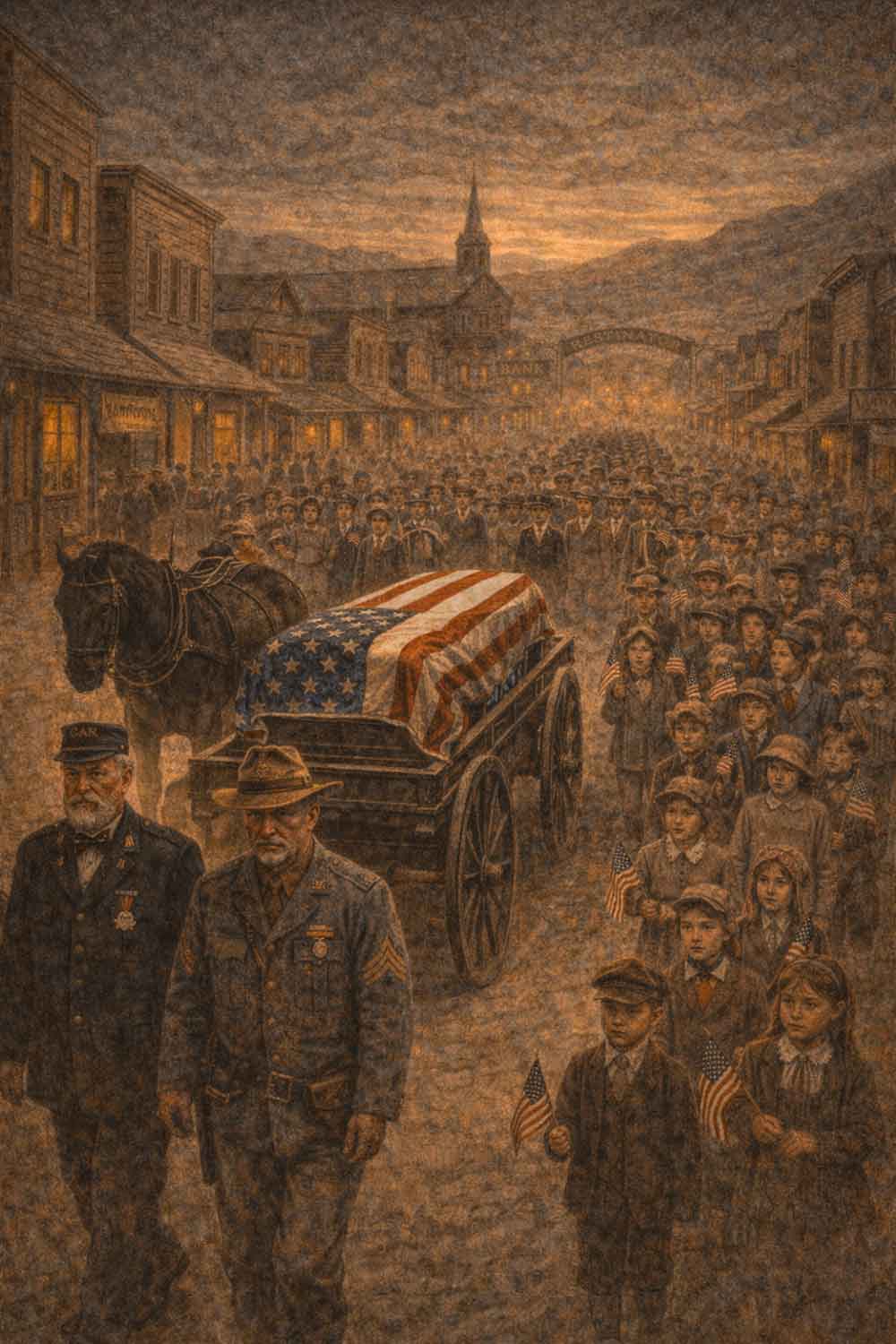
Booth’s funeral was held at Butler Hall under the auspices of the Grand Army of the Republic and the Spanish–American War veterans. Among those who followed the remains to the grave were nearly one hundred schoolchildren, who remembered his many acts of kindness toward them during his lifetime, particularly his presentation of an American flag to the schoolhouse in a special ceremony held only a few months earlier.
Booth never married. He was survived by his mother, two sisters, and two brothers.
CLICK ON THE IMAGE TO ENLARGE